The truth is, far too many people in our culture do not know what love is. And this not knowing feels like a terrible secret, a lack that we have to cover up. – Bell Hooks
I am in throws of dating and flexing muscles I haven’t moved in a long time. Six years ago, I decided to take a break from dating for the usual reason – two people not meant to be together tried to make it work and unsurprisingly both just walked away more jaded. Like a child found holding something they shouldn’t, I needed a time out. I couldn’t be trusted to choose a life partner or something in my instincts needed rewiring. It was meant to be a short sabbatical but nearly five years passed. I went on one date at around year two and that experience spurred me on to remain single and not mingling.
Last year, in a new city and under the usual societal pressures of why is a girl in her twenties not interested in or not dating, I ended up on dating apps. Dating apps are not for the faint hearted and definitely not for those just testing the waters, but in the maze of crazy I met someone who didn’t immediately make me want to find the nearest exit (let’s call him Mr S). We dated, but it was the same old; two people not right for each other trying to make it work. Again, I started to believe I couldn’t be trusted with this choice (was I actually going to let my sisters set me up?!). Had I wasted the five years and not learned anything?
I chastised myself, but didn’t withdraw and now I find myself navigating the adventure that is exclusively dating one person. In my obsession to not fail at dating Mr S, I realised I didn’t actually know how to be in a romantic relationship. I don’t know how to love or allow someone to love me. So like the good perfectionist I am, I enrolled in a program of self-learning. Out came the books, podcast and articles. I started with Bell Hooks’ book All About Love which is a theoretical exploration of love and loving. I am not a fan of relationship advice books (e.g. He’s Just Not That Into You and Think Like A Man) and my pride paints reading such books as a betrayal of my feminist roots so, Hooks was the perfect intersection of intellectual but not cringey. I also talked to the people in my life who I trust enough to explore this conversation with. I picked their brains and loved listening to them talk about their mishaps and the times it went right. I wasn’t trying to find a script or a ten point plan; do X and you will find Mr Right. They offered lessons on trusting the quiet voice inside often right, but more times silenced. Things ended with Mr S and thankfully, unlike 21 year old me, I understood that some things don’t work and that’s fine. Apologise (if needed), learn and move on.
Schools for love do not exist. Everyone assumes that we will know how to love instinctively. – Bell Hooks
I am going to confess something, despite the name my mother gave me, I struggle with love. Not familial love or that shared between friends. I have done enough turns round the sun to be comfortable with those relationships though i’m in no way perfect in its practice. Romantic love is an enigma and I am baffled at the confidence in which people have to walk into relationships. Is it naivety or hubris that makes them believe they are equipped with everything they need to love this new person? I love watching people love other people well or people (particularly my friends) being loved well. I have seen what good love looks like and have treasured some of its habits ready to adopt whenever I decide to stop living my best Tracee Ellis Ross life.
In my first year of university, I saw my housemate make her then boyfriend breakfast on his first day of exams. Their relationship dynamic and timetables meant this was a sacrifice on her part. Still at university, I went to a coffee that breaks all gender stereotypes and sat across the table from a male friend who talked (excitedly) about the many books he was reading about marriage and being a good husband (he was single at that time). He understood, that when the time came, marriage would be a chapter he had never done before and he wanted to be ready. He soon after met someone, got married and though I don’t know the ins and outs of their relationship, the years he spent preparing couldn’t have done harm.
Maybe we all know that loving is something we are unfamiliar with, but only a few of us are brave enough to acknowledge it and do the hard work of learning. Even if you find that you have previously been in a long committed relationship, when you enter a new relationship, you in a way return to step one. You have not loved that person before. You are not familiar with their quirks, the experiences that form the foundations of their life principles or are they even a morning person. An industry has been built around helping people navigating this learning process (36 questions that lead to love and five love languages) and though helpful, it seems as if one gender in particular carries the burden of this learning.
Maybe dating in itself is the crash course, but the more I date, the more I realise how unprepared and unequipped I feel. What are actual red flags and what is just me trying to find a reason to hit the eject button? How many times should we talk in a day/week and using what platform (must it be a video call every time?). Social media (particularly twitter) is loud about prescribing what is acceptable dating practice and what is someone doing the bare minimum (confession- I have googled how to tell if someone is doing the bare minimum. Not much in the way of helpful content, but if you feel the need to google something like that, that is a sign itself). Sometimes it looks as if people are living their relationship as set by the standards of Twitter instead of working out what the two people in the relationship (which should be the opinions that matter) care about and where their boundaries lie. Twitter raises interesting discussion points, but if it is the stick you use to measure your relationship with, that probably isn’t healthy.
To love and to be loved is confusing and hard. Yes, love is a verb that you must choose to practice everyday, but how to practice love is something you must also dedicate yourself to learning and relearning.
So, how did you learn to love and be loved?
The week that was:
Words of note –
If our experiences are inherently limited, understanding the world requires incorporating the experiences and welfare of others. Reacting against the idea of social Darwinism, Peirce instead thought that the logic of insurance and sampling inexorably led to “that famous trio Charity, Faith and Hope, which, in the estimation of St. Paul are the finest and greatest of spiritual gifts.” We must embrace others to understand the world – the imperative of experience gathering demands it. – Mihir Desai, The Wisdom of Finance
Thankful for –
1. life and health – this needs no other explanation
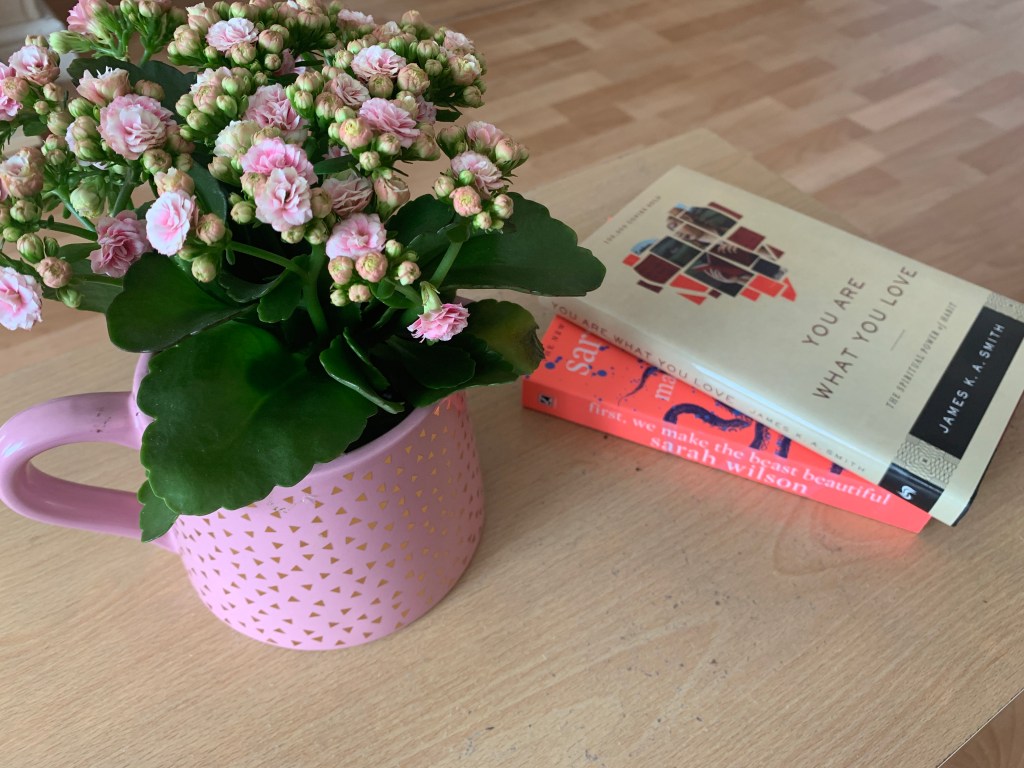
2. flowers and greenery – adding the cutie in the pink jug to my collection
3. OneRepublic – Didn’t I

 after the wilderness